
MORF-Bio began with a challenge familiar to many researchers, not a lack of data, but a lack of accessible insight.
The DETOX project, funded by IB Catalyst and led by Prof. Gavin Thomas at the University of York, set out to improve microbial strains for industrial biotechnology. The focus was on understanding how cells respond to product toxicity, not when they were added externally, but when they were formed inside the cell, thus representing industrially relevant conditions.
The Approach:
To investigate this, the team performed 1L fermentations of E. coli producing citramalate and styrene.
Time-resolved multi-omics data was collected to study the stress response, including transcriptomics, proteomics, metabolomics and lipidomics.
The project required a diverse set of skills and to enable the multidisciplinary team to easily integrate, interrogate and explore the vast dataset, a web-based data sharing platform was developed. Experienced bioinformatician Dr Vicki Springthorpe took on this challenge. The brief was to enable anyone, irrespective of coding skills or bioinformatics experience, to be able to access and interpret the data with ease, through their browser.
The Results:
Dr Springthorpe created a web-based platform where experimental observations were linked to annotated genomes, making it easy to browse vast datasets and determine not only target genes, but propose mechanisms of action.
On publication, the data then became publicly available, not just in a data repository built for bioinformaticians, but properly accessible to the community, through MORF:
- Citramalate was used as a negative control. It’s not toxic to the cell and accumulates to high levels with almost no effect.
- Styrene is very toxic and the cells start to die as soon as the pathway is induced.
The Outcomes:
Using data in MORF, the DETOX team were able to identify engineering targets that resulted in improving production of styrene in E. coli three fold.
A key component of the stress response was identified as the Psp operon, and Prof Thomas was awarded prestigious sLoLa funding to investigate this in more detail.
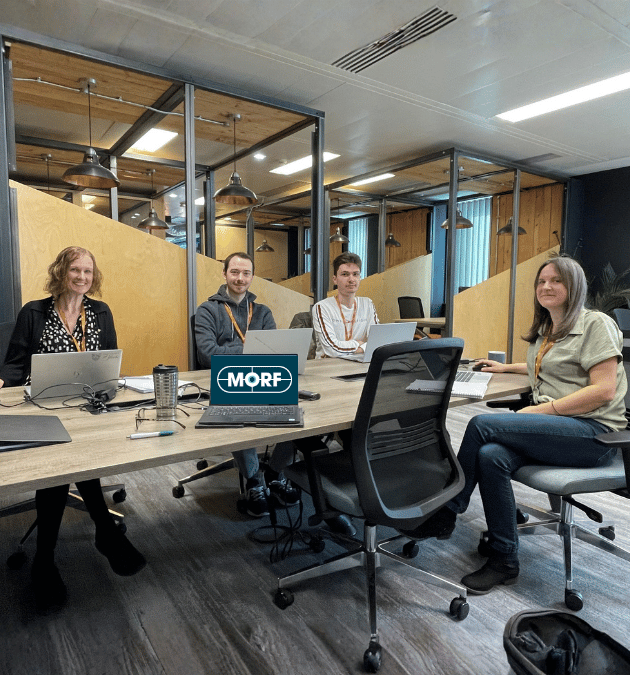
Having demonstrated traction in further research and industrial client projects, DETOX project manager, Dr Joyce Bennett led a successful fundraise that enabled her to spin out MORF along with cofounders Prof Thomas and Dr Springthorpe and form the company MORF-Bio.
What began as a way to make sense of a complex dataset has since evolved into a platform designed to accelerate discovery across microbiology and biotechnology.
We saw an opportunity to take our powerful tool and make it accessible to every researcher.
Joyce Bennett
CEO, MORF-Bio