
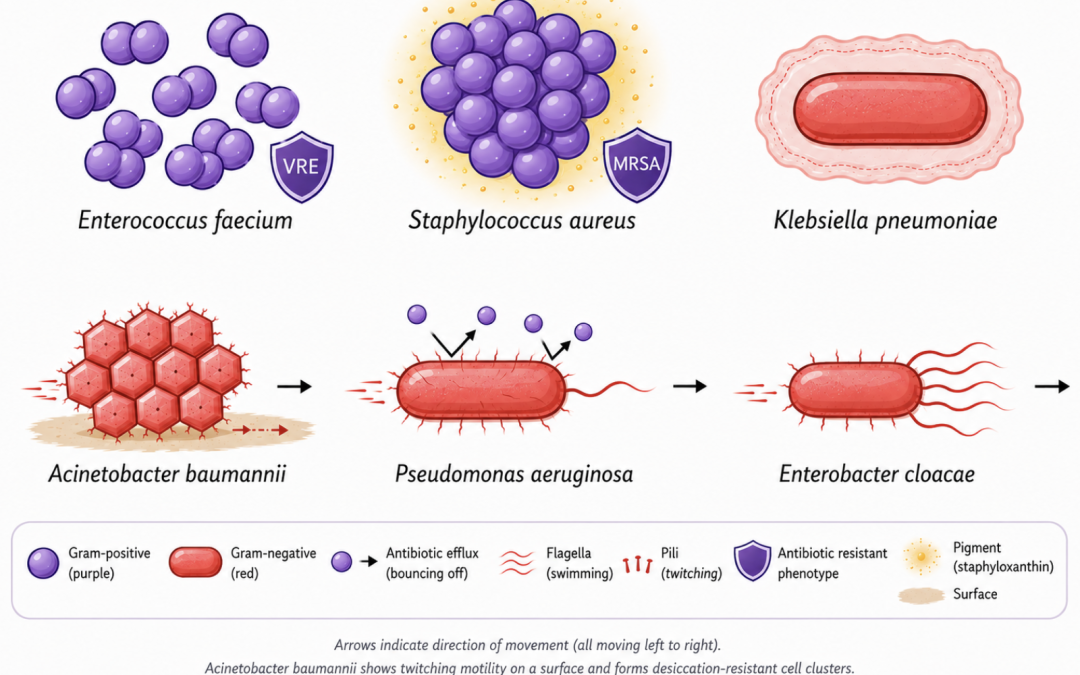
Why the ESKAPE pathogens are so hard to kill?
The 317 genes every superbug shares
Six of the most dangerous bacteria in medicine have far less in common than you’d expect. What they do share is exactly where our best antibiotics aim. That ought to make them easy to kill.
· Comparative genomics · Antimicrobial resistance · MORF Demos · Open access
Genomes compared
Orthogroups found
Genes shared by all six
Strain-specific groups
01 — The problem
They’re the hardest bacteria in medicine to kill
The WHO calls these six the ESKAPE pathogens: Enterococcus faecium, Staphylococcus aureus, Klebsiella pneumoniae, Acinetobacter baumannii, Pseudomonas aeruginosa and Enterobacter species.
Some have shrugged off virtually every class of antibiotic we have, leaving clinicians with nothing left to prescribe. Hospital-acquired infections kill hundreds of thousands of people a year, and these six are behind a large share of them.
How they do it is written in their genomes. Getting at it has always been the hard part.
02 — The approach
Six genomes, one comparison
We uploaded complete genome sequences for example strains of all six into MORF Genomes, then asked questions across the whole set at once.
Two tools did most of the work. Ortholog analysis, powered by OrthoFinder v3.1.3, compared every protein sequence in all six genomes simultaneously and sorted them into groups. BLAST let us take a single gene and ask which of the six carry anything like it.
No pipeline. No bioinformatician. Just a browser. The project is public as well, so every view below is a page you can open and click through yourself.
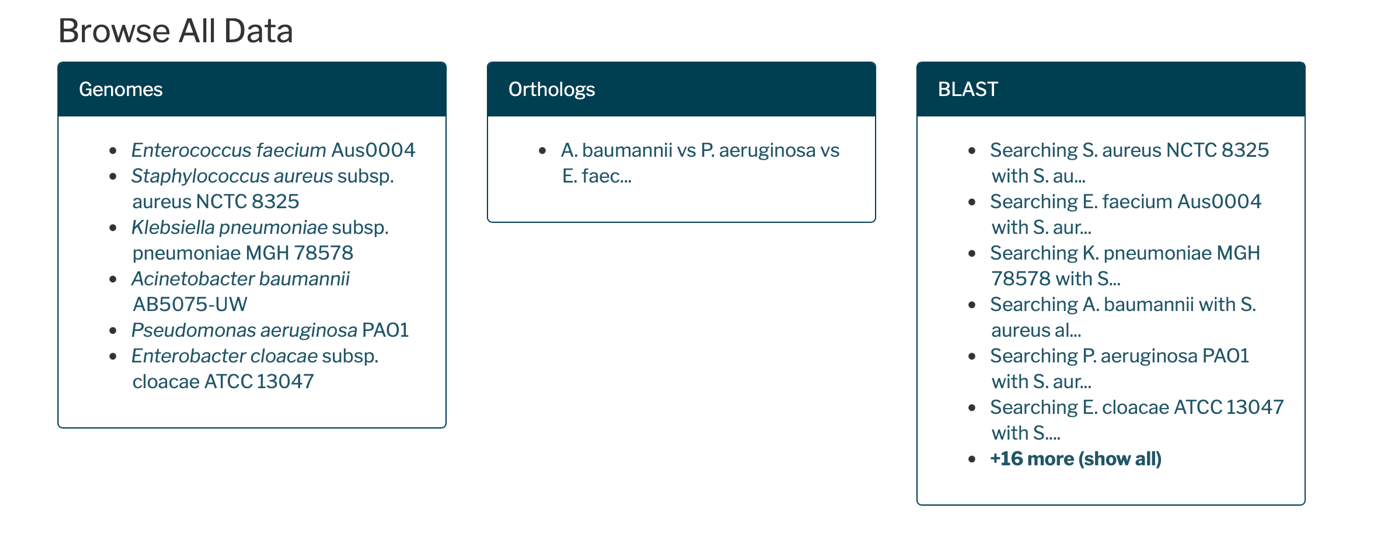
The project as it sits in MORF. Six genomes, the ortholog comparison across them, and every BLAST search run against the set.
They aren’t close relatives either. Genome sizes run from 2.82 Mb in S. aureus NCTC 8325 up to 6.26 Mb in P. aeruginosa PAO1. Two are Gram-positive, four are Gram-negative. They’re grouped by behaviour rather than by family tree, and that turns out to matter.
03 — What they share
10,070 gene groups. Only 317 in common.
Across the six genomes the analysis found 10,070 orthogroups. Just 317 genes turned up in a single copy in every one of them.
That’s a thin overlap for six organisms people routinely talk about as a group. Their common ancestor lived around 3 billion years ago, so those 317 genes have had plenty of time to get dropped. They haven’t been.
The project as it sits in MORF. Six genomes, the ortholog comparison across them, and every BLAST search run against the set.
- rpoB · rpoC RNA polymerase subunits, identical across all six. Target of rifampicin.
- rpsL 30S ribosomal protein S12, plus multiple 50S subunits. Target of aminoglycosides such as streptomycin.
- murB–murG Assembling peptidoglycans, for PBPs to build the cell wall. Where beta-lactams attack.
That’s no accident. The antibiotics that worked went after machinery no bacterium can do without.
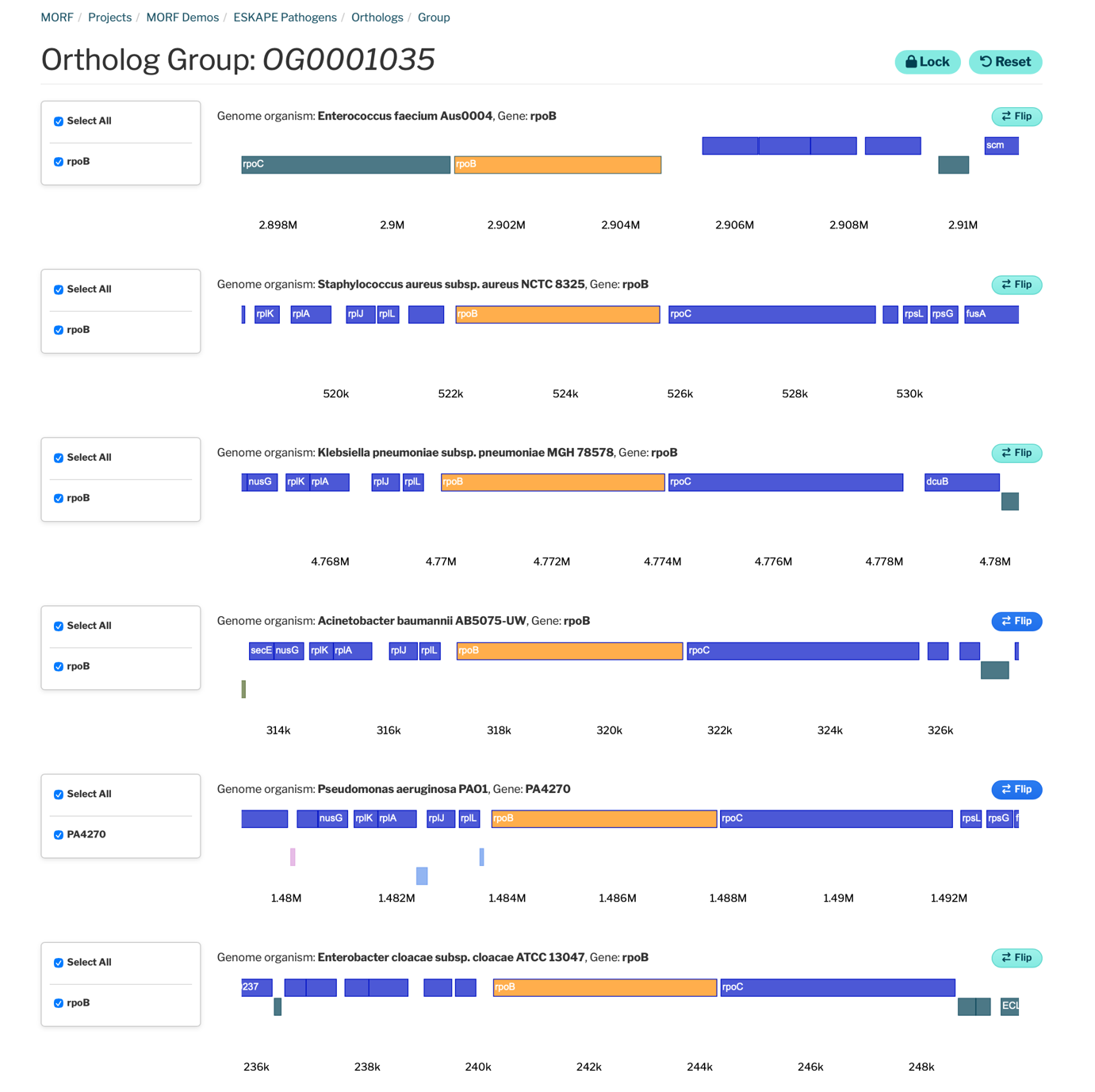
One orthogroup, six genomes. rpoB sits in the same neighbourhood in all of them, next to rpoC and the ribosomal protein genes. If an organism encodes the cluster on the reverse strand, one click flips it into line.
Every drug target in that list is present in all six organisms. All six resist the drugs anyway. So what is going on?
Carrying the target isn’t the same as being killed by the drug. Why that gap exists, and why most antibiotics work on far fewer organisms than their targets suggest, is in the mini review.
04 — What sets them apart
Because each one fights differently
There are also 598 strain-specific groups, genes that turn up in one pathogen and nowhere else. E. faecium has the most of its own, 139 of them. K. pneumoniae the fewest, at 77.
The S. aureus toxin arsenal belongs to it alone
We took the alpha-hemolysin protein sequence and BLASTed it against all six genomes. Inside S. aureus it pulled back a whole family: leukocidin subunits, leukotoxins LukD and LukE, gamma-hemolysin. Against the other five, nothing significant. Not one hit.
Those seven genes assemble into five working toxins. Nothing else in the group comes close, and it goes a long way to explaining why S. aureus infections do so much tissue damage.
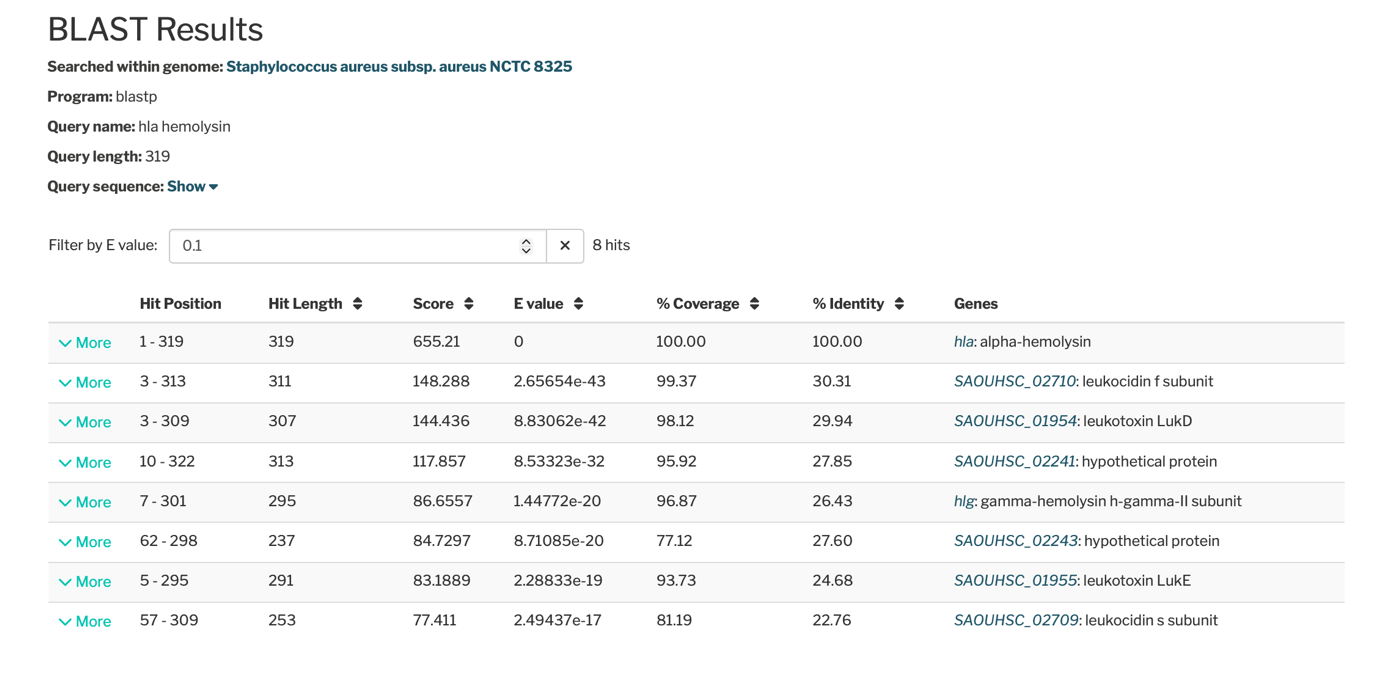
hla at 100% identity, with the rest of the family below it.P. aeruginosa is built to keep drugs out
Most Gram-negative bacteria have wide porin channels in the outer membrane. P. aeruginosa has smaller, fussier ones, and a lot more of them. In orthogroup OG0000039 alone it carries 19 porins, against 3 for A. baumannii, one each for K. pneumoniae and E. cloacae, and none at all for the two Gram-positives.
Look at the efflux pumps and the same pattern shows up. The others have a handful of RND transporters. P. aeruginosa has a column that runs off the screen.
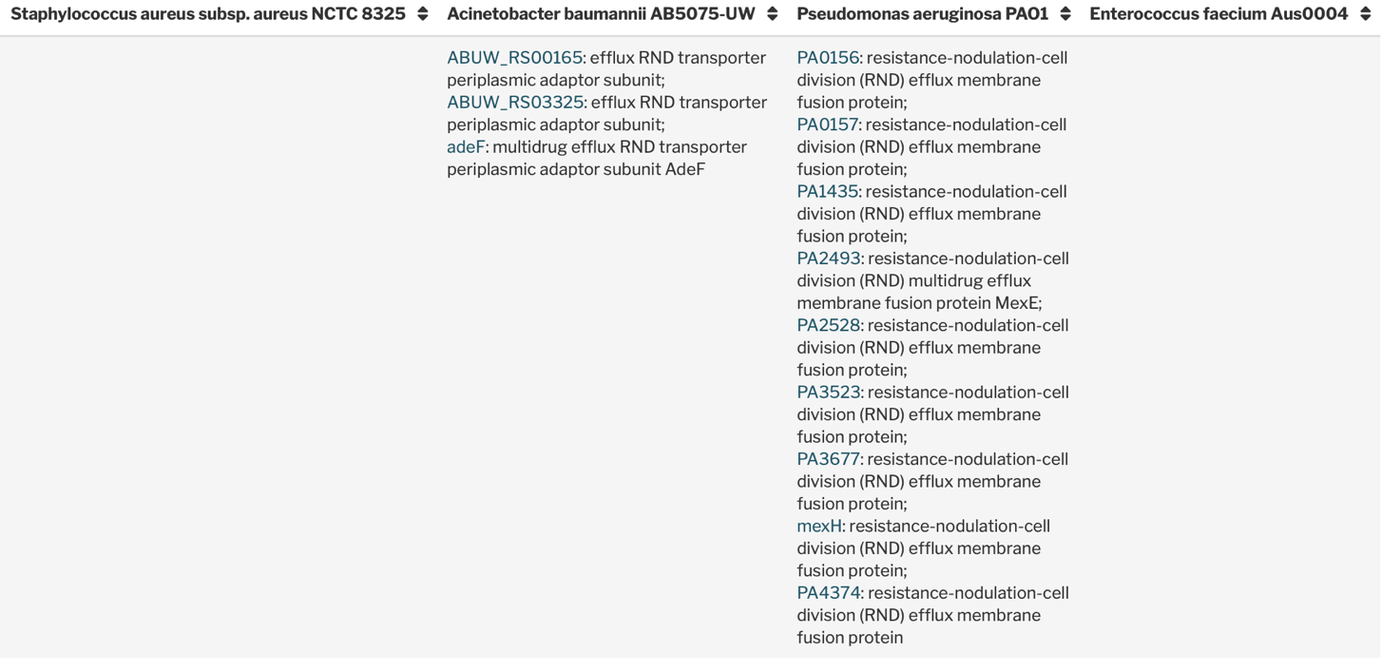
RND efflux transporters, one column per organism. The two Gram-positives have none, because they have no outer membrane for the pumps to span. P. aeruginosa has more than everything else put together.
Same label on the group. Six completely different answers to the same problem.
05 — Resistance in the act
You can see where it arrived from
Bacterial chromosomes keep a fairly steady ratio of G and C bases. DNA that arrived from somewhere else usually reads differently, and shows up as a spike.
In E. faecium, the vancomycin resistance cluster sits right under one of those spikes. Next to it are integrase and excisionase genes, the calling cards of a mobile genetic element. Something turned up, inserted itself into the chromosome, and stayed.
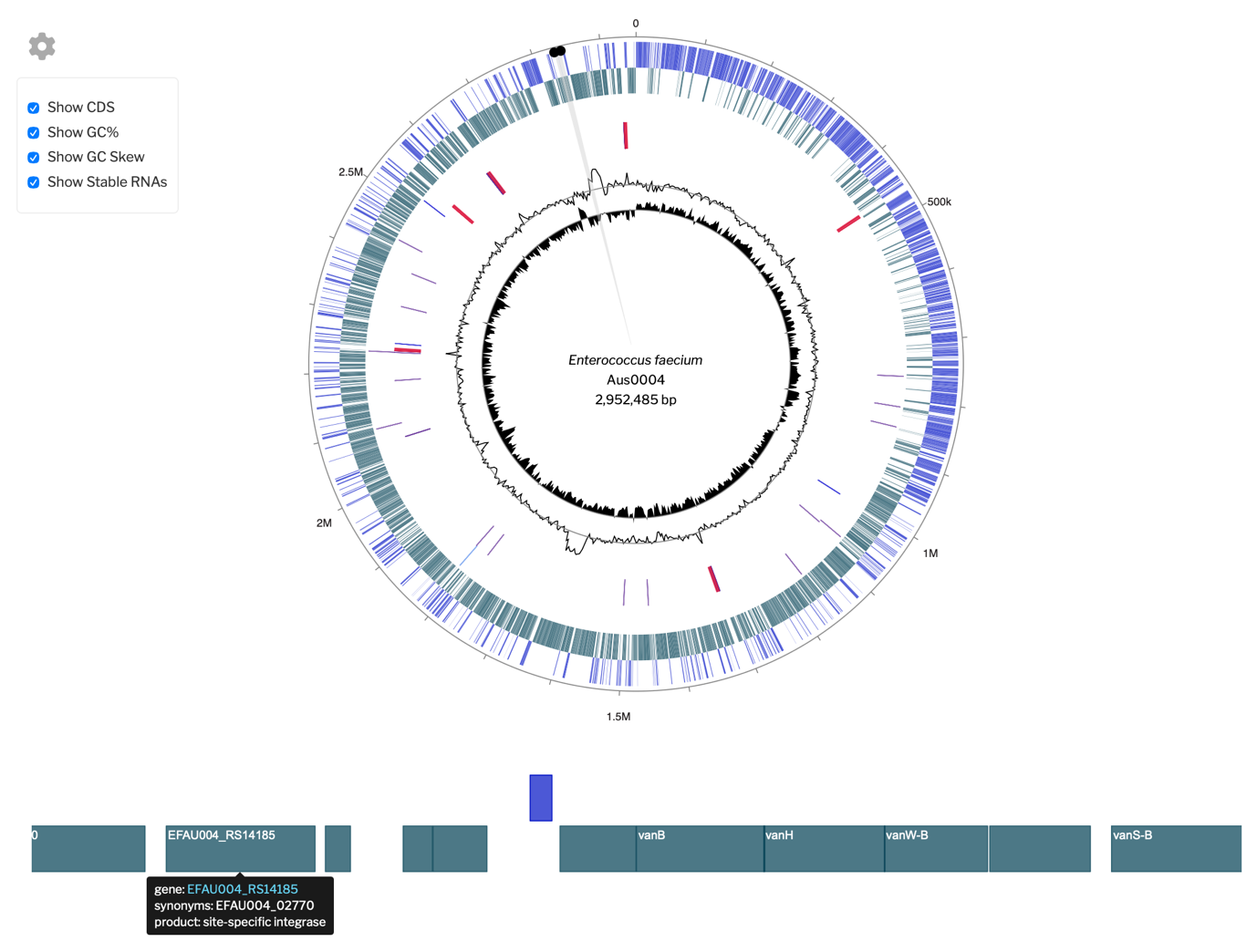
van array in E. faecium Aus0004, with a site-specific integrase a few genes upstream. The spike in the GC track above is what flagged the region in the first place.blaOXA-23, sits inside roughly 20 kb of phage DNA. A virus infected the cell, integrated into the chromosome, and happened to be carrying resistance to one of our last-line antibiotics. 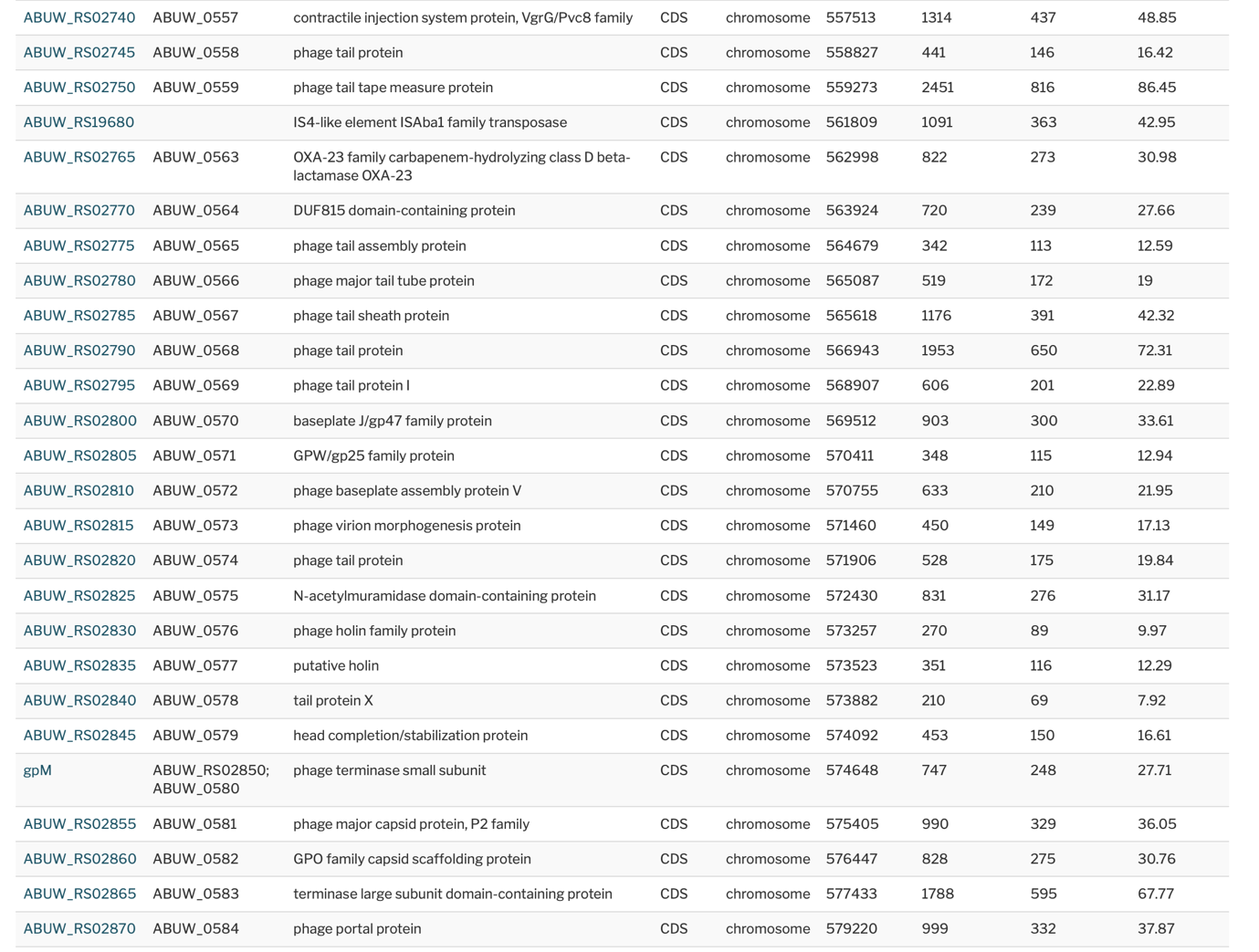
van array in E. faecium Aus0004, with a site-specific integrase a few genes upstream. The spike in the GC track above is what flagged the region in the first place.Neither one is subtle once you know what you’re looking at. Both show up on the genome map before you read a single gene name.
So why don’t the drugs work?
The gene being present is only the first condition. The mini review works through the rest of them.There are seven penicillin-binding protein orthogroups, not one, and each responds differently to different beta-lactams. Fluoroquinolones hit gyrA in the Gram-positives and parC in the Gram-negatives, which is why a single drug rarely covers both. P. aeruginosa carries three catalases that let it sit out an oxidative attack in the cystic fibrosis lung. And E. cloacae simply rebuilds its outer membrane when the current one starts letting drugs through.
Every figure on this page is a page in a public project. Open it, run the comparisons again, and check the conclusions for yourself. Then point the same tools at a genome you actually care about.
All six ESKAPE genomes are free to browse in the MORF Demos project at morf-db.org. No subscription, no account, nothing to install. MORF-Bio is a University of York spin-out.