
While industrial paper-making creates a massive bottleneck of toxic, lignocellulosic waste, a new multi-omics study has mapped exactly how a unique yeast strain overcomes this hostile environment to unlock new possibilities for bio-production
If you are a plant, lignin is great stuff. It’s a complex mix of phenolic polymers that plants deposit in their cellulose cell walls to make them rigid and resistant to decay, and allows them to efficiently transport water through their tissues. Lignin is the compound that turns plant tissues into wood, and allows trees to grow to great heights and widths, and as such, it’s the second most abundant biopolymer on the planet (after cellulose itself). But if you are a paper-maker, lignin is a bit of a nightmare; you’d really rather just have the cellulose from wood pulp, because lignin weakens paper, and is what makes it turn yellow with age. Paper factories therefore typically use the ‘Kraft process’ to remove as much lignin from wood pulp as possible, although this leaves them with a large quantity of ligno-cellulosic waste. And if you are an industrial biotechnologist, lignin is a puzzle – but an undoubted opportunity. Because within that complex mix of phenolic compounds there is a huge amount of stored chemical energy that would be a brilliant feedstock for bio-production – if only it could be accessed.
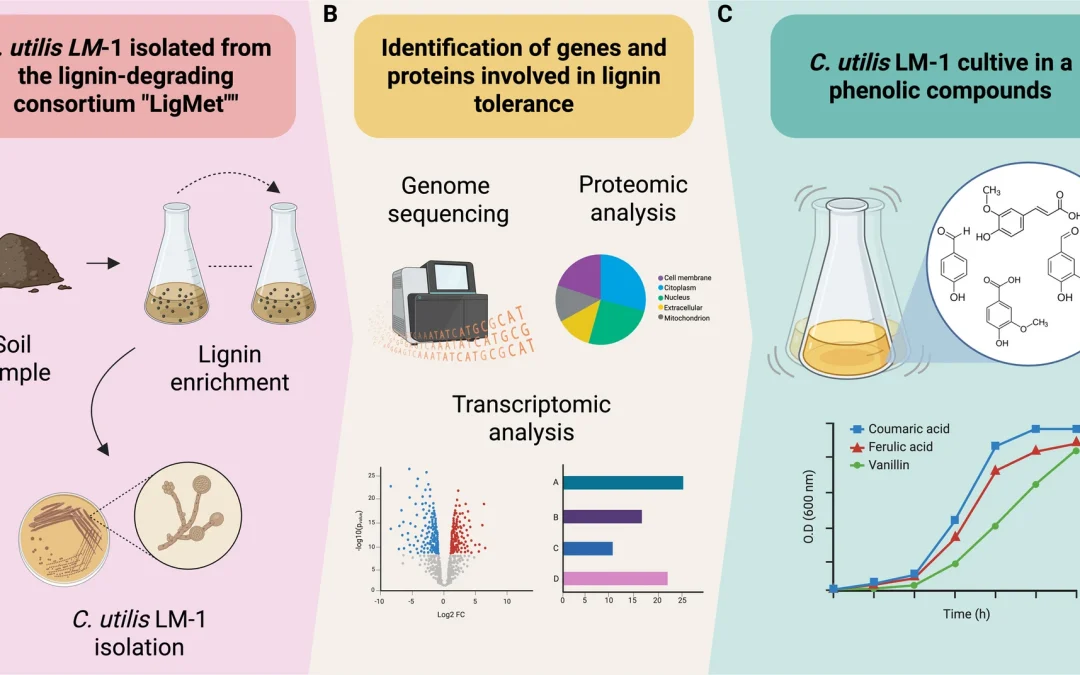
This is the problem that microbiologist Dr Robson Tramontina and colleagues have been investigating. There are of course plenty of microbes (including many fungi) that have evolved to degrade lignin, particularly fungi in the genus Rhodospirillium. However, in the context of industrial fermentations aiming to extract sugars from lignins, these organisms do not fare so well, becoming inhibited by the build up of chemicals such as 4-hydroxybenzaldehyde and 5-hydroxymethylfurfural that accumulate as the fermentation proceeds. These chemicals damage the cell membranes of the microbes, and cause intracellular oxidative stress leading to the damage of DNA and proteins. To identify new microbes that might be able to utilise lignin waste as a feedstock, Tramontina et al started with 1g of soil from a sugarcane farm in Brazil, and gradually cultured a microbial consortium that was able to grow on a lignin-rich substrate. Using genome sequencing, they then identified the yeast Candida utilis as the most prevalent microbial strain within the consortium. This fits well with what we already know, since C. utilis has previously been shown to grow well on substrates containing Kraft-derived lignin waste, despite the presence of high concentrations of phenolic compounds. But there was previously no indication how the microbe was able to do this, where so many others fail.
Tramontina et al therefore used a multi-omics analysis to compare the genes expressed, and the proteins produced by the microbe when grown in the presence or absence of Kraft-derived lignin. And this is where MORF stepped in. Omics data is only as valuable as the quality of its underlying genome annotations and for C. utilis, this was the first major challenge. To overcome this, MORF bioinformatician Dr. Vicki Springthorpe began by enriching the C. utilis genome annotations, successfully mapping functional details onto over half of the identified genes. By integrating this newly enriched dataset into the MORF platform, we were able to transform raw gene expression data into insightful functional data, easily visualised through interactive volcano plots, that instantly highlighted the key physiological changes.
MORF translated our unwieldy, incomplete dataset into clear, actionable physiological insights, saving us weeks of manual analysis and accelerating our understanding of the biological mechanisms at play.”
Dr Robson Tramontina
The results show that C. utilis uses a strategy of tolerance, rather than detoxification, to grow in the presence of phenolic compounds. The microbe does not show an increase in lignin degrading enzymes, but rather undergoes a metabolic remodelling aimed at preventing oxidative stress, through the massive upregulation of oxidoreductase enzymes to balance the cellular redox status, coupled with an upregulation of protein chaperones that help to keep proteins correctly folded. This is accompanied by a large increase in the expression of transporter proteins that help to keep the cell’s redox state balanced, and to remove the phenolic compounds from the cell, preventing as much damage as possible.
Overall, the results from Tramontina et al reveal the clever mechanisms by which C. utilis is able to tolerate an environment that few other microbes can, and make sense in terms of the known effects of phenolic compounds on microbial growth. Previous research has shown that C. utilis can be fermented in Kraft lignin waste to produce alternative protein sources and flavour enhancers, but that doesn’t necessarily mean that we can use C. utilis for industrial fermentations. It is one thing to be able to survive in this highly phenolic environment, but what is really required is an organism that can both survive in the environment and degrade and utilise the lignin as its primary fuel source. The work of Tramontina et al provides an excellent starting point for designing bio-engineering strategies that could convert common industrial microbes into lignin-degrading powerhouses.
Read the full paper here.